
Your cart is currently empty!
I Cannot Control What People Feel
I do not always know what I want people to feel when they look at my work. I am not especially interested in controlling that anyway.
When people explain what they like about my work, I often do not completely understand it. Sometimes they are not making sense, sometimes I am not making sense of them, and often both things are true. That is fine. Viewers cannot know exactly why I made something, and I cannot fully know what they are bringing to it.
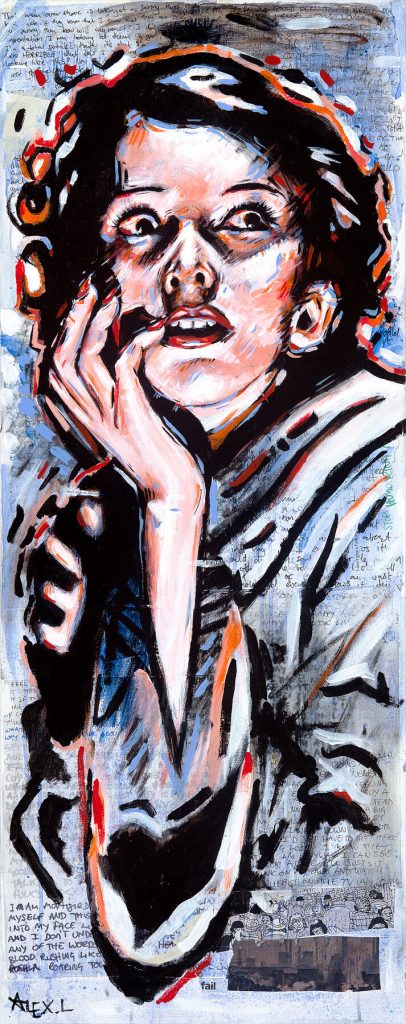
People often talk about intensity and vibrancy. That makes sense to me. Some of the work is closer, emotionally, to a pop video or an advert than to an old-master narrative painting. An old master can feel like watching a whole film: a scene from history, religion, mythology, or politics, full of story and symbols. My work often does something more immediate.
It does not always offer a story with a beginning, middle and end. Sometimes it offers an atmosphere, a charge, a feeling. That feeling may be bright, uneasy, funny, confrontational, sad, theatrical, or just visually pleasurable. I do not need every viewer to land in the same place.
I want to instil emotion, but I do not especially care which emotion. If people feel something, that is enough. If they stop, look, respond, and have an experience that belongs to them, then the work has done something useful.
I make work that satisfies me first. That is not arrogance; it is the only practical way I know to begin. If I like it, there is a decent chance at least one other person will like it too. Then the job becomes finding that person, which is the bit where things become socially and commercially awkward, because of course they do.
What interests me is that viewers often bring their own interpretations, stories, experiences and creativity to a painting. Their story may have very little to do with what I thought I was making. It may also be better and more interesting than my own. That is not a failure of communication. That is part of the point.
If people do that, I have created a connection and I have created meaning. Not necessarily my meaning, neatly delivered like a parcel, but meaning nonetheless. Culture works like that. The maker sends something out, the viewer meets it from their own life, and something happens in the space between.
If someone simply likes a piece because it is pretty, I will take that too, although I do not usually think of my own work as pretty. There are worse fates for a painting than giving someone pleasure. Not everything needs to arrive with a dissertation stapled to it.
I cannot control how people feel, and I have no interest in doing so.
This is part of a short series drawn from a longer interview about making art, process, aphantasia, mental health practice, and finding a more honest way to share the work.