
Your basket is currently empty!
In the Studio: An Interview with Alex Loveless
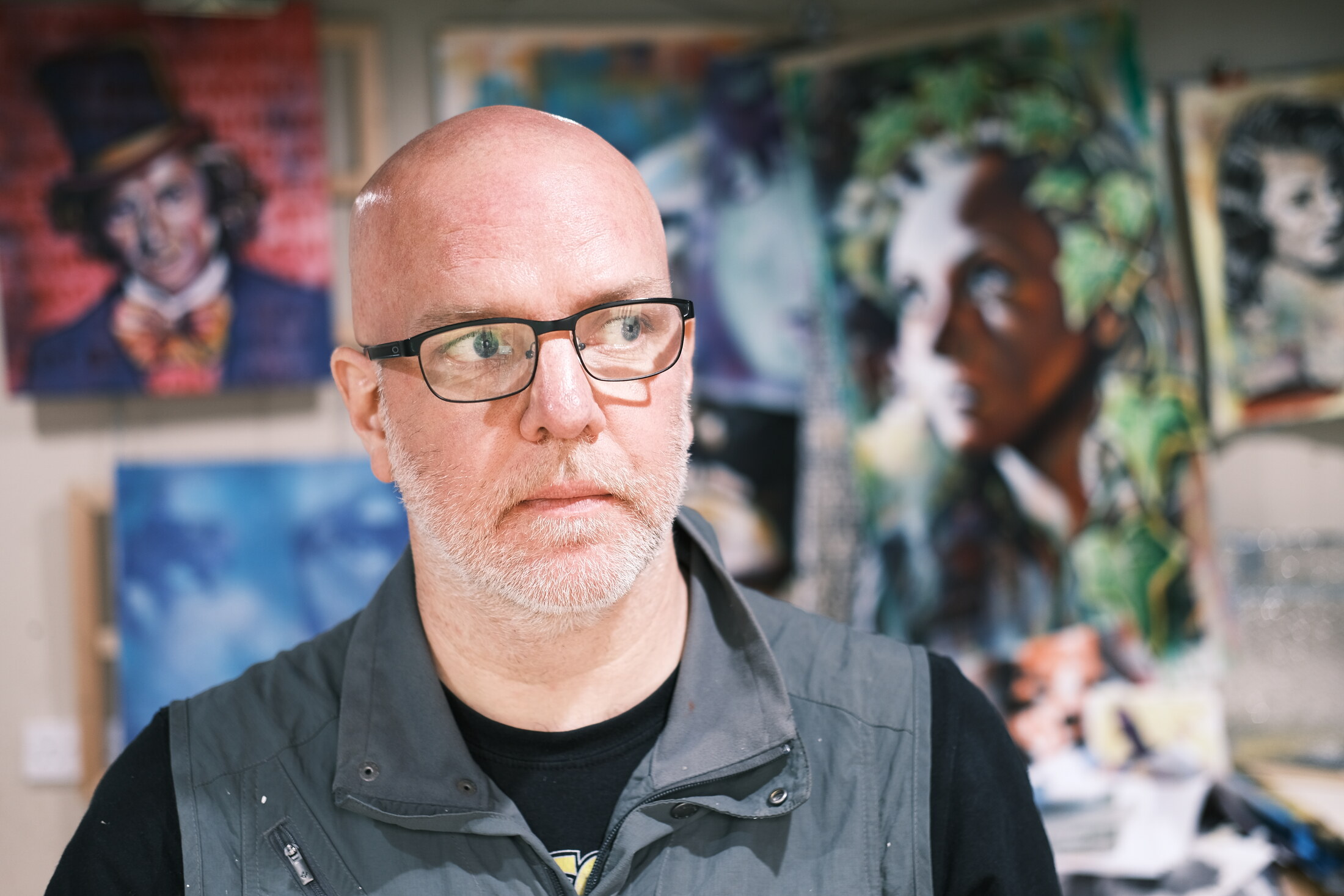
A longer Q&A with Alex Loveless on childhood monsters, aphantasia, process, mental health practice, and the awkward business of sharing work without turning it into a glossy artist-brand performance.
I never really thought of myself as an artist. Not at first, anyway.
This interview began as a conversation about how Alex came back to making art, why the process matters as much as the finished object, and how neurodivergence shapes the way he works. It has been lightly edited for clarity while keeping Alex’s voice intact.
Did you always think of yourself as an artist?
No. I never really thought of myself as an artist. Not at first, anyway.
As a child I drew monsters, vampires, fantasy beasts, zombies, comics, book covers and film posters because I liked them. I was trying to emulate people who could draw well, and trying to make my own versions of the images that grabbed me. There was no great artistic identity behind it. I was a kid drawing the stuff I loved looking at.
In my mid-teens I did start to wonder whether art might become a job. Then life wandered off in several other directions: television, film, media production, jobs on beaches overseas, the IT industry during the internet boom, family, children, and the long practical business of being an adult. Art did not disappear completely, but it thinned out into a trickle. By my thirties I would not have called myself an artist. I was someone who had a hobby sometimes.
It came back later through therapy and mental health practice. At first, painting was not about a market or an audience. It was about regulation. It gave my ADHD and autistic brain somewhere useful to go. Then I started making larger pieces, and some of them felt good enough that someone else might want them. Professional or not, selling or not, that changed the relationship.
Calling myself an artist still feels slightly odd, but it is useful. It gives a name to something that has become central again: making things, responding to images, working through colour, and connecting with people through the work itself.
What did art give you when it came back?
Escapism and self-esteem, mostly. It gives my brain something healthy to focus on.
Without something to focus on, my mind can turn in on itself. It can ruminate, chew things over, and get stuck in destructive thought cycles. A daily practice involving deep focus gives me an object of attention that is not simply another problem to solve by worrying at it.
I can get highly focused on programming as well, and I enjoy that, but it is intensive and exhausting. Painting gives me immersion without the same kind of depletion. I like the tactility, the materials, the experiments, the fact that each session at the easel is different.
The variety pleases the ADHD part of my brain. The structure, calm, allocated time and routine please the autistic part. Painting also gives quick feedback. Even one small successful part of a work in progress can produce a little self-esteem boost. The finished piece matters too: stepping back and thinking, yes, I like that, and then seeing someone else respond to it.
Art does not make problems disappear. It lets me stop focusing on them for a while, and stop trying to fix things I may not be able to fix. That break gives my brain time to recharge so I can come back to the rest of life with more strength.
I do not do this because I want to punish myself. I do this because I enjoy the process.
You talk a lot about process. What do you mean by that?
I do not separate the finished piece from the practice. The practice is the whole bloody lot of it: preparing canvases, stretching, priming, underpainting, making the work, finishing it, photographing it, displaying it, and eventually sharing it.
That view owes something to Zen, especially Dogen’s Shobogenzo and the idea that practice is not only the dramatic or elevated part. It is ordinary work as well. Getting dressed, eating, cleaning, preparing, repeating. All of that can be practice if you are actually present for it.
Painting has its own version. Stretching and priming a canvas is not the sexy bit, but it is still part of the artwork’s life. It is the beginning of the thing becoming possible. There are studio sessions where all I do is prepare surfaces, and at the end of the day I have not produced a painting, but I have produced possibility. The studio is suddenly filled with future work.
If I treat every stage only as a bridge to the next stage, I miss most of the experience. If stretching is only in the way of painting, and painting is only in the way of finishing, and finishing is only in the way of selling, then I have turned the whole thing into a queue of chores. That would be a spectacularly stupid way to approach the one thing I do partly to stay sane.
The finished object matters. So does seeing someone else connect with it. But the finished piece is one point in an ongoing process, not the only point that counts.
Does that way of thinking leave the studio?
It has to, really, although I am not pretending to be a Zen monk.
If everything is treated only as a stepping stone to something better or different in the future, then you are always running to catch up. You never quite arrive anywhere. You never appreciate or enjoy what is happening now.
A very ordinary example is lunch. People eat at a desk while staring at an email from an angry boss, despite having chosen a sandwich or meal they might actually enjoy. That sandwich might be the best part of the day, and they are not there for it. They are physically eating it while mentally being shouted at by someone who is not even in the room. Modern life: marvellous work, everyone.
The point is not that every moment is secretly wonderful. Some things are boring. Some things are unpleasant. Some things are genuinely painful. The point is that there is no way to remove badness from life. What matters is being present for the good parts, because those are what give you strength to handle the bad ones.
How does aphantasia affect your work?
Aphantasia has shaped the way I work. I do not have a reliable mind’s eye. I can think of a dragon eating a zombie, but I cannot see it clearly enough in my head to transfer that imagined image onto paper or canvas.
That ruled out certain childhood fantasies about being a comic artist in the conventional sense. I can understand the idea of a scene, but I cannot inspect it internally, rotate it, light it, dress it, or copy it from imagination. I need something external: a photograph, a model, an object, a generated reference, an accident on the canvas, something I can respond to in the world.
Colour works the same way. I may know which paints to reach for and I may know how to mix a particular shade, but the first time I really see the colour is when it appears on the palette or the canvas. That may be part of why vibrant colour matters so much to me. I do not see it internally, so making it physically is a genuine event.
I do not want simply to copy photographs. The method has to include chaos. I need accidents, disruption, texture and surprise because those things create novelty while I am working. A mark behaves oddly, a colour does something unexpected, a surface pushes back, and suddenly there is something to respond to.
The process has grown around my constraints, but the constraints are not only limitations. They are part of the shape of the work.
The first time I see the colour is when I have mixed it.
Do the childhood monsters and fantasy images still show up?
They are still there somewhere, but not always literally.
The childhood world of monsters, vampires, fantasy beasts, zombies, comics, posters, fantasy art and book covers is part of the visual soup I grew up in. It shaped what I found exciting in an image before I had any grown-up language for influence, style or subject matter.
Because of aphantasia, creating visual fantasy worlds from imagination alone is extremely difficult. I had a brief period making my own versions of pulp magazine covers, and I enjoyed parts of that, but it was harder and less relaxing because I was forcing the practice into an area where my brain does not naturally help me.
So the fantasy influence is often there as energy rather than literal subject matter: intensity, theatricality, heightened colour, dramatic faces, odd atmosphere, and the pleasure of an image that feels larger than ordinary life. The monsters never really went away. They just changed jobs.
What do you want people to feel when they look at the work?
I do not always know, and I am not especially interested in controlling that anyway.
When people explain what they like about my work, I often do not completely understand it. Sometimes they are not making sense, sometimes I am not making sense of them, and often both things are true. That is fine. Viewers cannot know exactly why I made something, and I cannot fully know what they are bringing to it.
People often talk about intensity and vibrancy. That makes sense to me. Some of the work is closer, emotionally, to a pop video or an advert than to an old-master narrative painting. An old master can feel like watching a whole film, full of story and symbols. My work often does something more immediate: atmosphere, charge, feeling.
I want to instil emotion, but I do not especially care which emotion. If people feel something, that is enough. If they stop, look, respond, and have an experience that belongs to them, then the work has done something useful.
Viewers often bring their own interpretations, stories, experiences and creativity to a painting. Their story may have very little to do with what I thought I was making. It may also be better and more interesting than my own. That is not a failure of communication. That is part of the point.
I cannot control how people feel, and I have no interest in doing so.
Is sharing the work part of the process too?
It should be. I enjoy showing the work. I like knowing that someone else has experienced it. Art gives me a way to connect with people that does not always require the usual social machinery, which is useful when that machinery can feel confusing or exhausting.
At the same time, I would still make art if nobody saw it. Quite a lot of work is rolled up in the studio. Some has been shared on Instagram, some has been seen by family or friends, and some has barely been seen by anyone else at all. Not because I am trying to hide it, but because showing it was not always the point at the time.
Selling art, promoting myself, building a customer base, building a follower base, talking about the work in public: all of that can feel difficult, unpleasant and emotionally confusing. Even taking a quick phone photo and sharing it can produce more anxiety than seems reasonable from the outside.
This website, the newsletter, the podcast and the social posts are all attempts to solve that problem in a more tolerable way. Not by inventing a glossy artist-brand performance, because that would be tedious as hell, but by finding a way to present the work and the thinking around it honestly, with as little unnecessary friction as possible.
I do not need to be seen as a genius, a style icon, a guru or a trailblazer. I want to make things that matter to me, and I want some of those things to find the people they might matter to as well.
I just want to bring a bit of joy into people’s lives by doing something that brings joy to me.
More from the studio
This interview is the source for a short series of studio notes on identity, influence, process, aphantasia, meaning, and sharing work. You can also browse the gallery, see available originals in the shop, or join the newsletter for occasional updates from the studio.