
Your basket is currently empty!
I went back to oil paint recently and immediately remembered why I had put it away for so long.
Not because I hate it. Quite the opposite, actually. I like the smell. I like the feel of it. I like the way it sits on the surface and the way it can be pushed, smeared, dragged, and coaxed into behaving a bit more like weather than like a tool. The problem is that oil paint arrives with baggage. A lot of baggage. Helpful baggage, maybe, but still a bloody lot of it.
There are rules. Apparently.
Fat over lean. Thick over thin. Drying times. Solvents. Mediums. Cracking. Archival concerns. Different ways of thinning paint depending on what you want to happen next. If you spend too long reading about it, it can sound less like making art and more like preparing for a conservation tribunal.
That is where the anxiety starts.
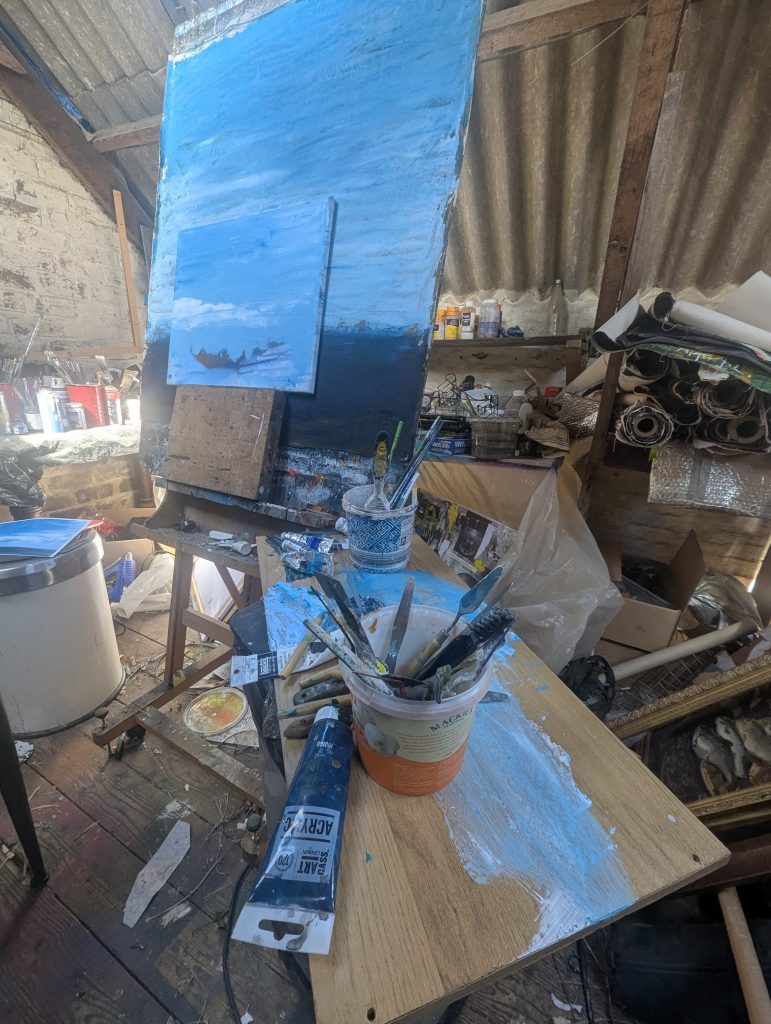
The trouble is not that the rules are nonsense. They are not. The trouble is that they can make the act of painting feel like a test you are already failing before you have even put brush to canvas. Once I start worrying that every mark is secretly a future disaster, I stop making sensible decisions and start staring at the materials like they are about to bite me.
Which is ridiculous, because the work I am making now is not some grand museum commission intended to survive a thousand years in ideal climate conditions with a team of conservators lovingly monitoring it. It is smaller, quicker, more experimental work. It is me playing with the medium, trying things out, and seeing what happens. It does not need to be treated like a national emergency.
That realisation helped.
When I stopped trying to become a master of oil technique in one afternoon and just got on with using the stuff, it turned out the process was much more intuitive than my anxious brain had been making it. If I want to underpaint, I can underpaint. If I want to work wet-into-wet, I can do that. If I want to keep the layers relatively simple because that suits how I work, that is fine too. The whole thing becomes far less intimidating once you accept that you do not need to win an imaginary conservation prize on day one.
I had a conversation with another artist about all this and, frankly, it did not help as much as it should have done. Not because she was wrong, but because my brain was already in the wrong gear. Sometimes the useful information is there and you still need to shut the anxious bastard up long enough to use it.
What finally broke the spell was a very simple thought: I do not need to follow every rule with religious terror. I just need to know enough not to be reckless.
That is true of a lot of things, not just painting. Knowing the basics matters. Understanding why a material behaves the way it does matters. But there is a point where technical caution turns into avoidance with a respectable haircut. If you are too busy worrying about whether a small canvas might crack in a hundred years, you are not actually making the small canvas.
At some point I decided that was silly.
It probably helped that I was looking at work by Turner in a technique book and seeing examples of things that had not aged perfectly. If one of the greats can have material issues and still occupy a whole wing of Tate Britain, I think I can survive my own minor compromises. I am not trying to produce eternal masterpieces. I am trying to make paintings that feel alive now.
That is the useful bit. Alive now.
The irony is that once I gave myself permission to stop overthinking it, the medium became more enjoyable. The tools made sense. The pace made sense. The smell, the texture, the slowness, the way oil paint encourages you to think differently all started to feel like advantages rather than problems.
I still suspect I’ll wander off and obsess about something else in a few weeks or months. That is what I do. I move through things in bursts. But that does not make the burst less real while it is happening.
So for now I am painting in oils, not because I have become a devout convert to the Church of Proper Technique, but because I like the material and I like what it lets me do. I am following the basics, not panicking about the rest, and trying to remember that the point of the studio is not to avoid every possible future problem.
The point is to make the thing.